
There’s no better way to immerse in the wonders of Antarctica than by getting to know some of its curious wildlife species. At Antarctica21, we're privileged to introduce our guests to the true stars in our destinations: penguins! These remarkable birds have evolved specialized adaptations to thrive in one of Earth's most extreme environments. Not only do some penguins mate for life, but they’re also known to value community and live in large colonies along the continent’s rocky shores, always on the prowl for a meal of fresh krill to feed themselves and their young. And while Antarctica is home to some of the most iconic species, the penguin story extends well beyond the ice. The wildlife-rich shores of the Falkland Islands (Malvinas) and South Georgia host their own remarkable species, from the burrow-dwelling Magellanic penguin to the cliff-hopping Southern Rockhopper.

When you book an itinerary aboard one of our boutique vessels, our expert guides help you understand penguins and their fascinating adaptations and behaviors. Observing penguin colonies during our expeditions offers unparalleled insights into the complex ecosystems of Antarctica and the remarkable resilience of life in this frozen landscape. Let's explore the unique characteristics of the penguin species our guests may encounter across our Antarctic air-cruises and sub-Antarctic sea voyages.
Gentoo Penguins (Pygoscelis papua)
Gentoos have a circumpolar distribution, with colonies found on the Antarctic Peninsula, sub-Antarctic islands, and even as far north as the Falkland Islands (Malvinas).
Likelihood on Antarctica21 cruises: Very high.
Gentoos are commonly seen on the Antarctic Peninsula and surrounding islands, making them a frequent and delightful sight for our guests. Easily identified by their white "bonnets" and bright orange bills, Gentoos are the third-largest penguin species. They're known for their adaptability, with a distribution extending beyond Antarctica to sub-Antarctic islands. Gentoos are excellent swimmers, capable of diving up to 200 meters deep and reaching speeds of 36 km/h underwater. Their diet primarily consists of krill and small fish, which they hunt using their streamlined bodies and powerful flippers. Interestingly, Gentoos are monogamous during breeding seasons and often return to the same nesting sites year after year.

Adélie Penguins (Pygoscelis adeliae)
Adélies have a circumpolar distribution in Antarctica, with major populations in the Ross Sea region and along the Antarctic Peninsula.
Likelihood on Antarctica21 cruises: High to moderate, depending on the time of year.
Adélies are more abundant earlier in the season (November to early December) before they move further south. Named after Adélie Land, the Antarctic territory that French explorer Jules Dumont d'Urville named in honor of his wife, Adélies are true Antarctic specialists. They're easily recognized by the distinctive white rings around their eyes. These medium-sized penguins are incredibly well-adapted to the cold, with stiff, brush-like feathers that provide excellent insulation. Adélies are known for their impressive migrations, often traveling over 17,000 km round trip each year between their breeding colonies and winter feeding grounds. They're also indicators of environmental change, with populations fluctuating in response to variations in sea ice coverage and krill availability.

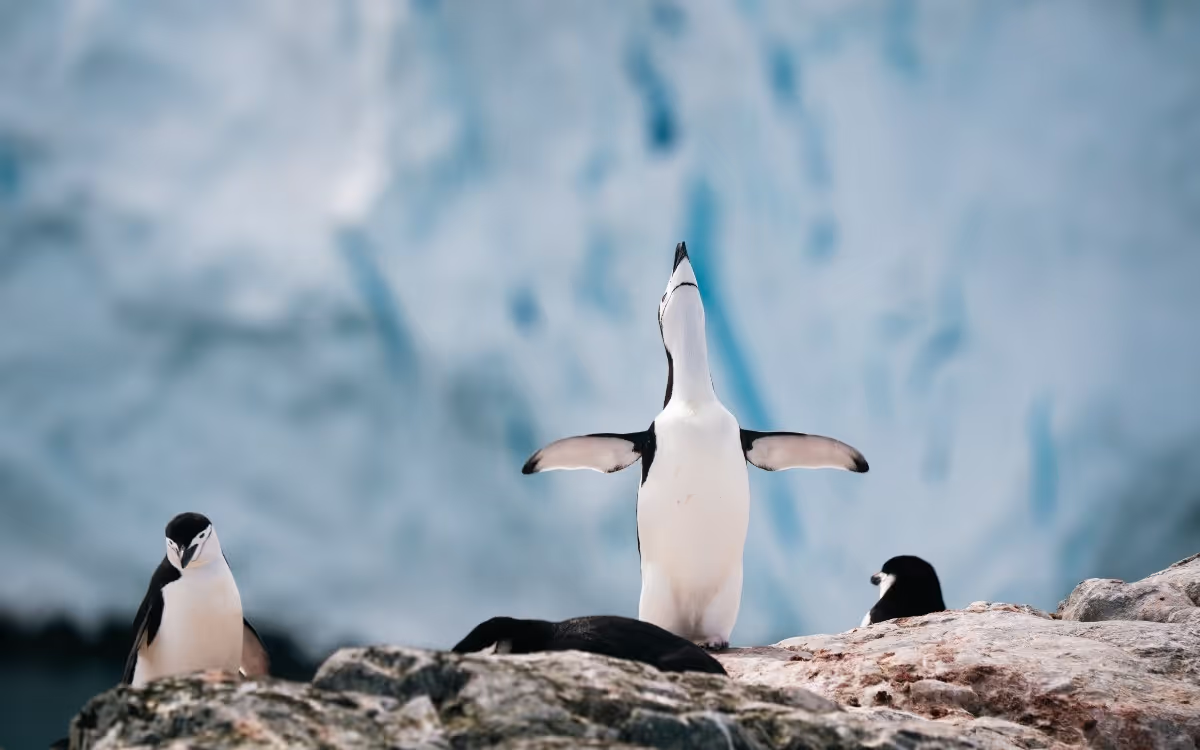
Chinstrap Penguins (Pygoscelis antarcticus)
Chinstraps are found primarily on the Antarctic Peninsula, South Shetland Islands, South Orkney Islands, and other sub-Antarctic islands.
Likelihood on Antarctica21 cruises: High.
Chinstraps are commonly seen on the Antarctic Peninsula and nearby islands, often in large colonies. Distinctive for the narrow black band under their heads, Chinstraps are abundant in the Antarctic Peninsula region. These penguins are remarkably agile, both on land and in water. They can leap up to 2.5 meters out of the water onto rocky shores. Chinstraps are primarily krill feeders and can dive to depths of 70 meters in pursuit of their prey. Their breeding colonies can be enormous, sometimes containing over 100,000 pairs. Interestingly, Chinstraps are known for their loud, harsh calls, which have been compared to a donkey's bray, earning them a reputation as one of the noisiest residents of the Antarctic Peninsula.

Emperor Penguins (Aptenodytes forsteri)
Emperors are found around the entire Antarctic continent, but their colonies are typically located on stable pack ice in areas that remain frozen year-round.
Likelihood on Antarctica21 cruises: Very low.
Emperor penguin colonies are generally too far south to be visited on standard Antarctic Peninsula cruises. However, occasionally, individual Emperors might be spotted. The largest of all penguin species, Emperors stand at an impressive 1.2 meters tall. They're supremely adapted to the extreme Antarctic environment, capable of surviving temperatures as low as -60°C and winds up to 200 km/h. Emperor penguins have unique breeding biology: they're the only penguin species to breed during the Antarctic winter. Males incubate a single egg on their feet for about 65 days, fasting the entire time and losing up to 45% of their body weight. Emperors can dive deeper than any other bird, reaching depths of over 500 meters and staying submerged for up to 22 minutes.

King Penguins (Aptenodytes patagonicus)
King penguins are found on sub-Antarctic islands, including South Georgia, Crozet Islands, and Macquarie Island.
Likelihood on Antarctica21 cruises: Very low on Antarctic Peninsula air-cruises; high on voyages that include South Georgia.
King penguins are occasionally seen on voyages that include South Georgia. Second only to Emperors in size, King penguins are distinguished by their striking orange-gold neck patches. Kings have a lengthy breeding cycle that takes 14-16 months, unlike most penguins, meaning they can only produce two chicks every three years. Their chicks have distinctive brown down feathers, historically leading sailors to mistake them for a separate species. King penguins are exceptional divers, regularly reaching depths of 100-300 meters in search of their preferred prey: small fish and squid. They have remarkable navigational abilities, able to locate their breeding colonies on sub-Antarctic islands after months at sea.

Macaroni Penguins (Eudyptes chrysolophus)
Macaroni penguins have a circumpolar distribution, breeding mainly on sub-Antarctic islands such as South Georgia, the South Sandwich Islands, and the South Orkney Islands.
Likelihood on Antarctica21 cruises: Very low on Antarctic Peninsula air-cruises; possible on voyages that include South Georgia or the Falkland Islands (Malvinas).
Macaroni penguins are rarely seen on standard Antarctic Peninsula itineraries, but may be encountered on voyages that include sub-Antarctic destinations like South Georgia. Easily recognized by their striking yellow-orange crest feathers, these penguins are among the most numerous of all penguin species. They typically inhabit steep, rocky coastlines where they form vast and dense breeding colonies. Macaroni penguins primarily feed on krill, along with small fish and squid, and are skilled divers capable of reaching significant depths in search of food. Despite their large global population, their numbers have shown signs of decline in recent decades, making them a species of growing conservation interest.
.webp)
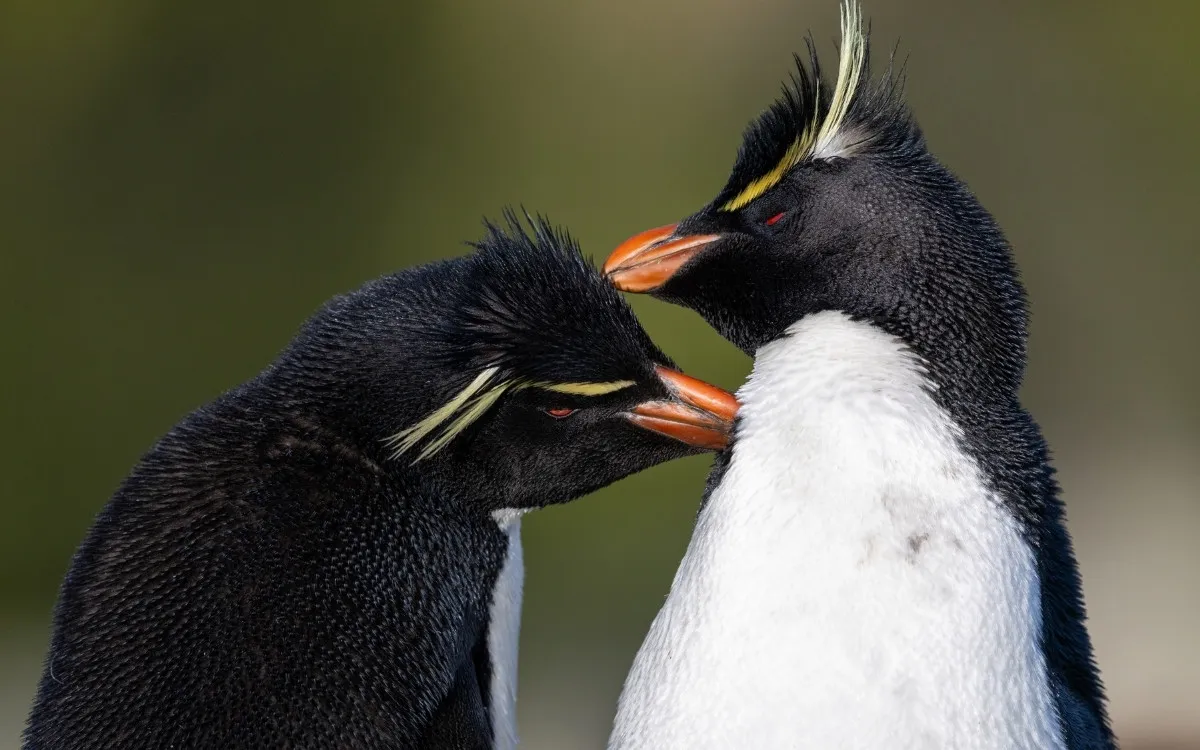
Southern Rockhopper Penguins (Eudyptes chrysocome)
Southern Rockhoppers are found on sub-Antarctic islands, including the Falkland Islands (Malvinas), islands off southern Chile and Argentina near Cape Horn, and other locations across the South Atlantic and Indian Oceans.
Likelihood on Antarctica21 cruises: High on Falklands (Malvinas) sea voyages; very low on Antarctic Peninsula itineraries.
The smallest of the Falklands' penguin species, Southern Rockhoppers stand at roughly 50 cm tall and weigh between 2.5 and 4 kg. They are perhaps the most instantly recognizable penguins in the sub-Antarctic, sporting spiky yellow and black crest feathers, vivid red eyes, and a stout orange-red beak that gives them a permanently punk-rock appearance. Their common name comes from their extraordinary habit of bouncing up steep, rocky cliffs with both feet together, rather than waddling or sliding like most other penguin species. Capable divers, they plunge to depths of 100 meters in pursuit of krill, squid, and small fish, sometimes spending several consecutive days at sea before returning to their colonies. The Falkland Islands hold one of the largest populations in the world, with an estimated 320,000 breeding pairs spread across 35 colonies on islands such as Steeple Jason, Beauchene Island, and Grand Jason. Rockhoppers arrive in the Falklands each September to breed and remain through April before migrating to winter feeding grounds along the Patagonian Shelf, as far as the Strait of Magellan and Cape Horn. Listed as Vulnerable by the IUCN due to significant population declines over the past century, they are a species of growing conservation concern, making each encounter with them all the more meaningful. Guests on our Falklands (Malvinas) and Falklands (Malvinas) & South Georgia sea voyages can expect to observe their boisterous, charismatic colonies at close range on islands like New Island, West Point Island, and Saunders Island.
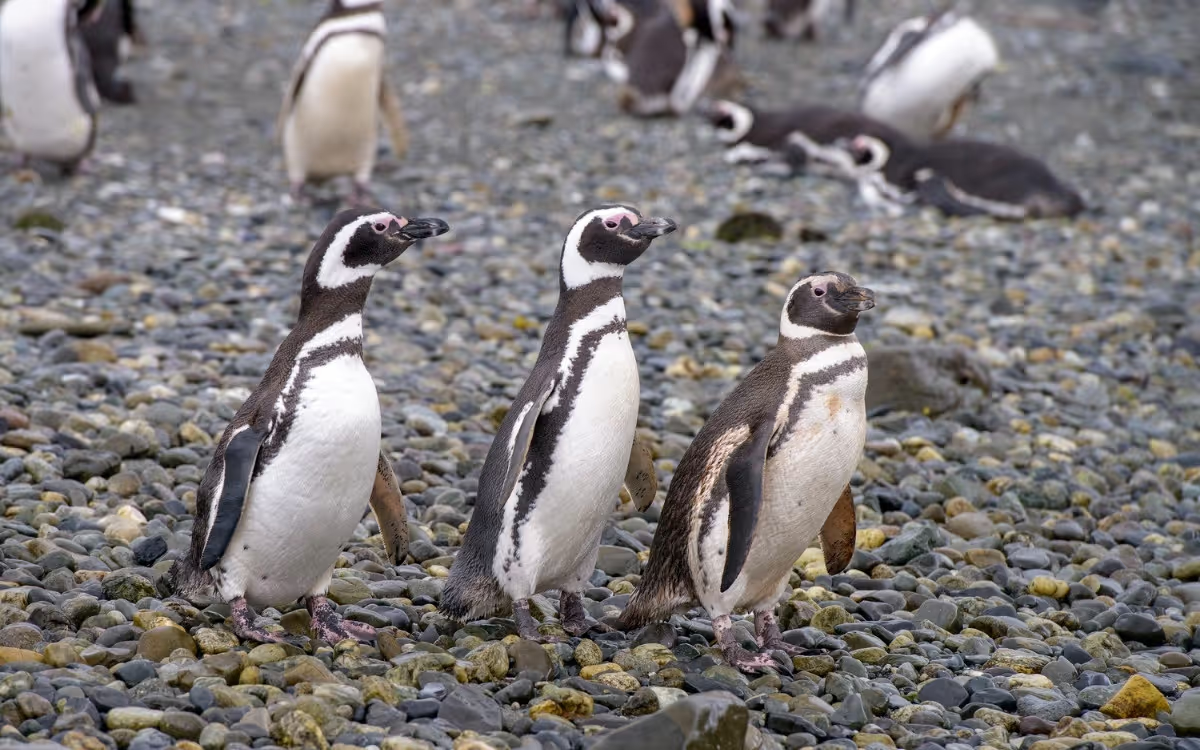
Magellanic Penguins (Spheniscus magellanicus)
Magellanic penguins breed along the coasts of Argentina, southern Chile, and the Falkland Islands (Malvinas), with winter migration routes extending as far north as southern Brazil and Uruguay.
Likelihood on Antarctica21 cruises: High on Falklands (Malvinas) sea voyages during the austral summer (October to March); not present on Antarctic Peninsula itineraries.
Named after the Portuguese explorer Ferdinand Magellan, whose crew first documented them during his 1520 voyage through the strait that now bears his name, Magellanic penguins are the most numerous of the banded penguin species. Medium-sized and elegantly marked, they are identified by the distinctive black and white horseshoe-shaped bands across their chest and throat, a stout grey-black bill, and a patch of bare pink skin around the eyes. Standing between 61 and 76 cm tall, they are notably the only Falklands penguin species to nest in burrows, which they excavate up to two meters deep into peat and soft coastal soil. This underground architecture provides shelter from predators and the Falklands' relentless wind. An estimated 100,000 breeding pairs inhabit the islands, arriving in September and departing by late April. Magellanic penguins are monogamous and remarkably faithful, returning to the same mate and the same burrow year after year. Females recognize their partners by call alone. They feed primarily on small fish and squid, with adults diving regularly to depths of 20 to 50 meters, and during incubation they may travel up to 500 km to forage before returning to relieve their partner. Shyer than other Falklands penguins, they tend to retreat into their burrows when approached, which has earned them the local nickname "Jackass penguins" for their loud, mournful braying call. Guests on our Falklands (Malvinas) sea voyages can observe them at Volunteer Point, Carcass Island, Bleaker Island, and Pebble Island, where they share the coastline with gentoos, rockhoppers, and king penguins in one of the South Atlantic's richest wildlife spectacles.
Whether you find yourself surrounded by a colony of thousands on a South Georgia beach, watching Rockhoppers bounce up a Falklands cliff face, or locking eyes with a curious Gentoo on the Antarctic Peninsula, these encounters leave a lasting impression. Every expedition is an invitation to connect with the natural world and carry that sense of wonder home as a commitment to protecting it.
Learn how you can have a chance to see them on a journey with us!
.avif)
.jpg)
.jpg)
Experience the Extraordinary
From dramatic landscapes to close wildlife encounters, every journey to the White Continent is unique. Let's start planning yours together.

Stay In Touch With Antarctica
Subscribe to be the first to know about new season launches, early booking promotions, brochures, future contests, and more.

