.avif)

Antarctica is closer than you think. Today, a growing number of travelers are discovering the White Continent aboard small expedition vessels that serve as floating base camps, navigating through ice-filled channels where towering glaciers meet the sea and wildlife thrives in extraordinary abundance. This is what an Antarctica cruise looks like: not a conventional cruise, but an expedition into one of the most remote, pristine environments on Earth.
In this article, we cover everything you need to know about Antarctic cruises, from choosing the right ship and understanding costs, to when to travel and what you will actually see and do once you arrive in Antarctica.
In this article:
- What is an Antarctica cruise?
- How to choose the right ship for an Antarctica cruise
- How to travel to Antarctica
- When is the best time to take an Antarctic cruise?
- What can you see and do on an Antarctica cruise?
- How much does an Antarctic cruise cost?
- What to pack for an Antarctic cruise
- Frequently asked questions
- Start planning your Antarctic expedition with Antarctica21
Whether you are in the early stages of dreaming about the White Continent or actively planning your Antarctic voyage, this article will help you make informed decisions about one of the most extraordinary journeys on the planet.
What Is an Antarctica Cruise?
An Antarctica cruise is nothing like a traditional cruise. On a conventional cruise ship, the vessel itself is the destination, packed with entertainment, casinos, and pools designed to keep guests occupied for days at sea. An Antarctic cruise flips that idea entirely. Here, the ship is your base camp, your floating home for roughly five days of exploration, and the expedition is the experience.
In simple terms, an Antarctica cruise is a voyage through the most remote, pristine, and awe-inspiring environment on Earth, designed to bring you face to face with massive ice shelves, breaching whales, resting seals, and penguin colonies. Every day brings new landings, Zodiac excursions, and encounters with a landscape that very few people on the planet will ever witness firsthand.
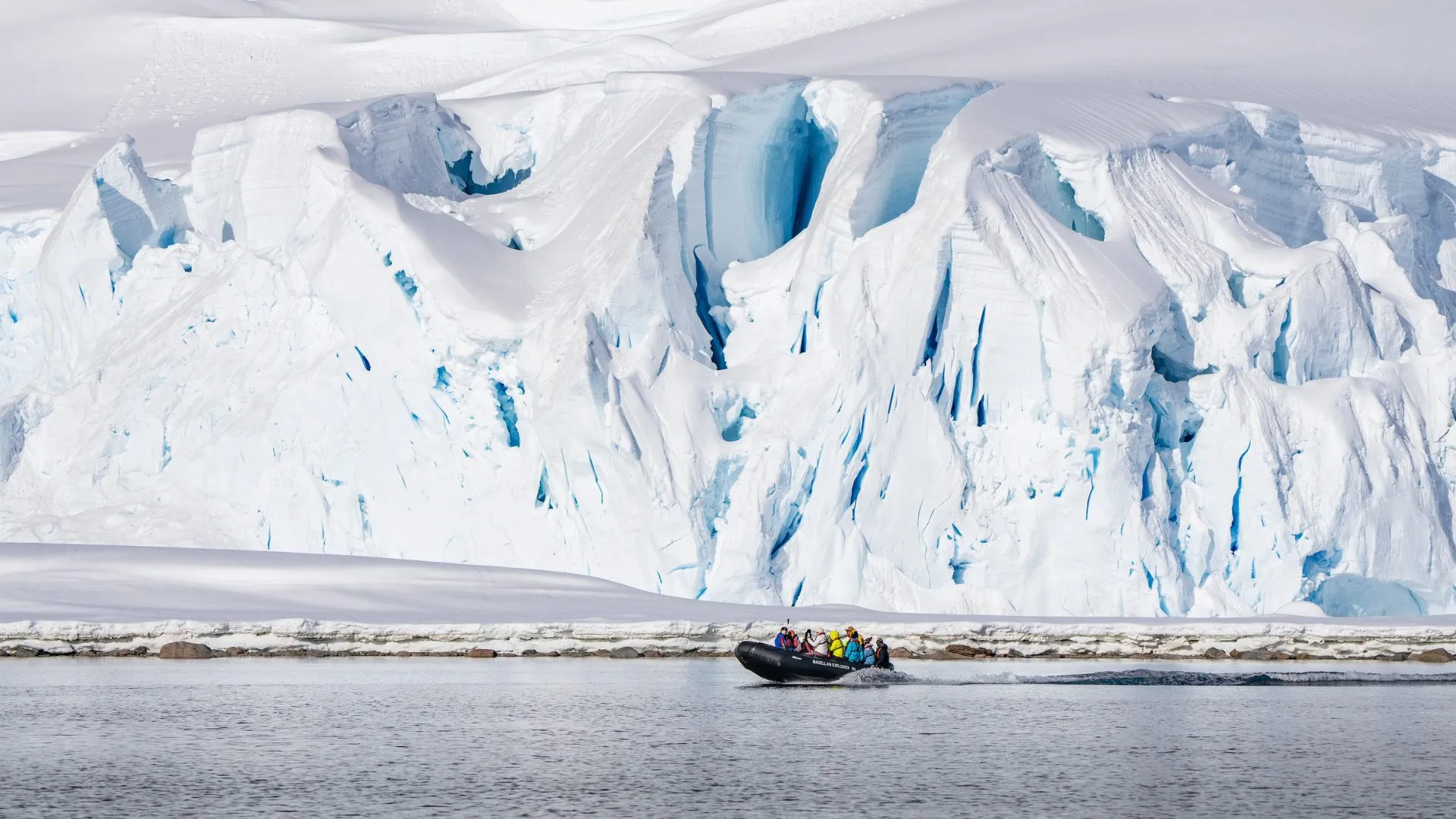
These expeditions typically explore the Antarctic Peninsula. Ships navigate through ice-filled fjords and narrow channels, where towering glaciers descend into the sea and sculptural icebergs drift with the currents. Along the way, each journey reveals a constantly changing landscape shaped by wind, water, and ice, offering a profound sense of the scale and beauty of the White Continent.
A team of expert polar guides, naturalists, and lecturers leads every expedition, delivering onboard presentations and coordinating small-group excursions. These include guided shore landings, Zodiac cruises, and optional kayaking, all conducted under strict environmental guidelines to ensure a safe, responsible, and meaningful experience.
It is important to understand that no two expeditions are the same. Weather conditions play a key role in shaping every Antarctic cruise. Flexibility is essential. The expedition team sets the route each day based on weather, ice, and wildlife activity, which means every voyage is a unique and unrepeatable experience.
.webp)
How to Choose the Right Ship for an Antarctica Cruise
The ship you choose will define your entire Antarctic experience. This is one of the most important decisions you will make when planning your expedition, and it deserves careful thought.
Ship size matters
At Antarctica21, we offer Antarctic air-cruises on board two boutique expedition vessels: Magellan Explorer and Magellan Discoverer. Both ships were purpose-built for Antarctic expeditions and carry a maximum of 76 guests on air-cruises. This is no small detail, and here is why: according to the International Association of Antarctic Tour Operators (IAATO), no more than 100 people may set foot on land at any one site at any one time.
While most Antarctic cruise operators exceed that threshold and must rotate groups, Antarctica21 can disembark all guests at the same time, which means more time exploring the wildlife, landscapes, and ice formations of this extraordinary ecosystem.
Small ships also access narrow channels, secluded bays, and ice-filled passages that larger vessels simply cannot navigate. If your goal is to truly explore Antarctica rather than just see it from a distance, a boutique expedition vessel like Magellan Explorer or Magellan Discoverer is the way to go.
Purpose-built vs. converted ships
Some Antarctic expedition ships were originally built for other purposes, such as research or commercial shipping, and later converted for passenger use. Others were purpose-built from the start for polar exploration.
Purpose-built expedition vessels tend to offer better stability, more advanced ice-strengthened hulls, and interiors specifically designed for the demands of polar travel. They also feature modern safety systems and Polar Code compliance, which means they meet the latest international standards for ships operating in polar waters.
At Antarctica21, both of our expedition vessels were custom-built in Chile at the ASENAV shipyard, specifically for Antarctic expeditions. Magellan Explorer launched in 2019 and has been operating air-cruises to the Antarctic Peninsula ever since. Magellan Discoverer, our newest addition to the fleet, features hybrid-electric propulsion and a Polar Class 6 ice rating, entering service for the 2026-27 season. Both ships feature private balconies in most cabin categories, a glass-enclosed observation lounge, a fleet of Zodiacs for shore landings, and an intimate atmosphere where you quickly get to know your fellow explorers and the expedition team. The interiors were designed by Chilean studios, and you will find premium Chilean wines served with every lunch and dinner on board.
What to look for in your ship
When comparing Antarctic cruise options, pay attention to these factors:
- Guest-to-guide ratio: A lower ratio means more personalized attention on shore excursions and better wildlife interpretation. While IAATO requires a minimum of 1 guide for every 20 guests, Antarctica21 maintains a remarkable 1:6 guest-to-guide ratio, meaning more polar experts at your side throughout your expedition.
- Zodiac fleet: Each of our small ships features 10 or 12 Zodiac boats. More Zodiacs means more efficient shore landings and more time exploring.
- Cabin and suite with a boutique feel: After a day of exploration in cold temperatures, returning to a comfortable cabin with a private balcony overlooking the ice makes a real difference.
- Onboard program: Look for operators that offer expert lectures, citizen science programs, and educational content that deepens your understanding of the region. Antarctica21's A21 Connect program brings together science, education, and hands-on experiences throughout every expedition.
- Sustainability practices: Antarctica is one of the last truly wild places. Choose an operator committed to minimizing its environmental impact. Antarctica21 is a CarbonNeutral® certified company since 2019, and Magellan Discoverer features hybrid-electric propulsion with a Selective Catalytic Reduction (SCR) system for reduced emissions.
.webp)
How to Travel to Antarctica
Getting to Antarctica is part of the adventure, and you have two main options: sailing the Drake Passage or flying over it.
Sailing the Drake Passage
The traditional route to Antarctica departs from Ushuaia, Argentina, and crosses the Drake Passage, the body of water separating South America from the South Shetland Islands. This is where the Atlantic, Pacific, and Antarctic oceans converge, making it one of the most turbulent stretches of water on the planet.
The crossing takes approximately two days in each direction, which means about four full days of your trip are spent at sea. Conditions can range from surprisingly calm (the so-called "Drake Lake") to extremely rough, with swells that can reach several meters. For travelers who are prone to seasickness, this crossing can be a challenging part of the journey. That said, many travelers consider the Drake crossing a rite of passage and enjoy the opportunity to spot albatrosses, petrels, and whales along the way.
Sea voyages that include the Drake Passage crossing are typically 10 days or longer and offer a deep sense of the remoteness of Antarctica. Some itineraries also visit the Falkland Islands (Islas Malvinas) and South Georgia before or after the Antarctic Peninsula, creating extended expeditions of 18 or more days.
Flying over the Drake Passage: the air-cruise model
For travelers who want to maximize their time in Antarctica and skip the rough seas of the Drake, there is another option: the Antarctic air-cruise.
Antarctica21 pioneered this model in 2003 and has led more Antarctic air-cruises than any other operator. The concept is simple but transformative: instead of spending two days sailing across the Drake Passage, you fly from the city of Punta Arenas, the Chilean gateway to Antarctica, directly to King George Island in the South Shetland Islands, where the ship is ready to receive you. The flight takes approximately two hours. Upon landing, you board a Zodiac and head straight to your expedition vessel.
This approach offers three key advantages:
Comfort: You bypass the stormiest waters on Earth entirely. No rough seas, no seasickness, no sleepless nights riding swells.
More time exploring: By eliminating four days of ocean crossing, you gain significantly more time for landings, Zodiac cruises, and wildlife encounters in Antarctica.
Small-ship intimacy: Antarctica21 ships carry a maximum of 76 guests per air-cruise, with a dedicated flight for each departure. All guests can disembark at once in the fleet of Zodiacs, so you never waste time waiting for your turn to go ashore.
Air-cruise itineraries range from 6 to 18 days, depending on the program. The Classic Antarctica Air-Cruise (8 days / 7 nights) is the most popular option, offering a complete Antarctic experience with multiple landings, Zodiac excursions, and wildlife encounters. Longer programs include the Polar Circle Air-Cruise (10 days), which ventures farther south in an attempt to reach the Antarctic Circle, and the Antarctica and South Georgia Air-Cruise (18 days), which combines the Antarctic Peninsula with the extraordinary wildlife of South Georgia.
Departing from Punta Arenas, Chile
All Antarctica21 air-cruises depart from Punta Arenas, the capital of the Magallanes Region in Chilean Patagonia. This historic city has served as a gateway to Antarctica for over a century. During the Heroic Age of Antarctic Exploration, many important expeditions departed from Punta Arenas on the way south. Today, it is home to Explorers House, Antarctica21's expedition center, where your journey begins.
Explorers House is a beautifully restored, century-old building spanning over 2,000 square meters (21,500 sq ft). Here, you attend pre-expedition briefings, meet your fellow travelers, and enjoy a welcome dinner before your flight to Antarctica the following day. The facility features a library, lounges, a gift shop, interactive touch screens, and a presentation room, all designed to build anticipation and prepare you for the expedition ahead.
Beyond the expedition itself, Punta Arenas offers easy access to Torres del Paine National Park, one of Patagonia's most stunning natural landscapes, making it possible to combine your Antarctica cruise with a world-class Chilean Patagonian experience.
%2520(1).webp)
When Is the Best Time to Take an Antarctic Cruise?
The Antarctic season runs from November to March, which corresponds to the austral summer in the Southern Hemisphere. During these months, temperatures along the Antarctic Peninsula typically range from approximately -2°C to 8°C (28°F to 46°F), and daylight can last up to 22 hours per day.
Each month within the season offers a distinct experience:
November (Early Season): This is when Antarctica emerges from winter. The ice is still thick and dramatic, the landscapes are blanketed in fresh snow, and you can witness the beginning of the breeding season. Adélie and gentoo penguins build their nests, Weddell seals appear with newborn pups, and the first humpback and minke whales begin arriving in Antarctic waters.
December and January (Peak Season): These are the warmest months and the period of peak wildlife activity. Penguin chicks hatch and populate colonies across the peninsula, leopard seals hunt near penguin rookeries, and whale sightings become more frequent. The long hours of daylight create extraordinary conditions for photography and exploration. This is also the busiest period, so booking early is recommended.
February and March (Late Season): As the season progresses, penguin chicks become more independent and begin to molt. Whale-watching reaches its peak, as humpbacks, minkes, and orcas feed intensively before their northward migration. The light shifts to warmer, golden tones that photographers love. Late-season expeditions often encounter more dramatic ice formations as glaciers calve into the sea.
There is no single "best" time to visit. The right month depends on your priorities. Antarctica21 recently published "When to Travel to Antarctica," a month-by-month guide to the highlights of every part of the season along the Antarctic Peninsula.
.webp)
What Can You See and Do on an Antarctic Cruise?
An Antarctic expedition is one of the most active and immersive travel experiences you can have. Forget the idea of lounging on deck all day. In Antarctica, you are out on the water, on the ice, exploring, observing wildlife, and absorbing landscapes that will stay with you long after you return home.
Wildlife encounters
Antarctica is home to some of the most abundant and accessible wildlife on the planet, and during the austral summer, the Peninsula comes alive with activity.
Penguins are the stars of any Antarctica cruise. Along the Peninsula, you will encounter gentoo penguins with their distinctive orange beaks, Adélie penguins in their classic black-and-white plumage, and chinstrap penguins named for the thin black line that runs under their heads. Depending on the timing of your visit, you may witness nest-building, egg incubation, chick-rearing, or the lively bustle of a busy penguin highway between colony and sea.
Whales are a constant highlight. Humpback whales are the most commonly sighted, often seen breaching, tail slapping, or bubble-net feeding in the nutrient-rich Antarctic waters. Minke whales are known for their curiosity, sometimes approaching expedition vessels for a closer look. Orcas, with their unmistakable black-and-white markings, hunt in coordinated family pods and are one of the most thrilling sights in the Southern Ocean.
Seals are a regular presence. Weddell seals, known for their gentle demeanor, often rest on ice floes near the ship. Leopard seals, the top predators of the Antarctic food chain, patrol the waters with a powerful, prehistoric presence. You may also encounter elephant seals and the abundant crabeater seals hauled out on floating ice.
Seabirds fill the skies, from the magnificent wandering albatross with its enormous wingspan to snow petrels, giant petrels, and Antarctic skuas.
Activities and adventures
Beyond wildlife observation, Antarctic expedition cruises offer a range of activities designed to connect you with the environment from different perspectives.
Zodiac cruising is the backbone of every Antarctic expedition. These nimble inflatable boats allow you to navigate through ice-choked passages, approach glacier faces up close, and weave among icebergs that tower above you. Zodiac excursions are led by expert guides who know how to read the ice and position the boat for the best possible encounters with wildlife.
Shore landings bring you onto Antarctic soil (or ice) for guided walks through penguin colonies, past historic research stations, and along beaches where seals rest just meters away. Every landing is a carefully managed experience, following strict environmental guidelines to protect the fragile ecosystem.
Sea kayaking offers a uniquely intimate perspective. Paddling through crystalline waters among icebergs and ice floes, with the sound of cracking ice and calling birds as your soundtrack, is an experience that stays with you long after you return home. At Antarctica21, the sea kayaking program is a small-group experience limited to 20 participants, led by an experienced Kayak Master.
Hiking and snowshoeing take you to elevated vantage points for sweeping views of the surrounding glaciers, bays, and mountain ridges. Each excursion is led by expert guides who select the best routes based on weather and terrain conditions.
The Polar Plunge is a tradition for the boldest explorers. A quick dip into the frigid Antarctic waters is an exhilarating rite of passage that earns you serious bragging rights when you get back home.
Education and learning
A great Antarctic expedition is also an educational one. On board Magellan Explorer and Magellan Discoverer, you can attend presentations from polar experts, naturalists, and scientists on topics ranging from photography, glaciology, and marine biology to the history of Antarctic exploration.
Through the A21 Connect program, Antarctica21 brings science and learning to life during every expedition. Guests can also participate in citizen science programs, contributing to real research by conducting phytoplankton surveys, monitoring whale migrations, or collecting environmental data. Learn more about the Citizen Science program.
How Much Does an Antarctic Cruise Cost?
An Antarctic expedition is a significant investment, and prices vary widely depending on the type of voyage, the ship, the cabin category, and the length of the itinerary.
As a general guide, here is what you can expect:
Sea voyages (sailing the Drake Passage) departing from Ushuaia on small expedition ships typically start in the range of $9,000 to $15,000 USD per person for standard cabin categories on 10- to 12-day itineraries. Premium cabins and suites, as well as longer itineraries that include South Georgia or the Falklands (Malvinas), can be significantly higher.
Air-cruise expeditions (flying over the Drake) are priced at a premium that reflects the convenience of the flight, the smaller ship size, and the additional time spent exploring in Antarctica. At Antarctica21, air-cruise prices for the 2026-27 season start at approximately $15,995 USD per person for the Classic Antarctica Air-Cruise, an 8-day itinerary with five days exploring Antarctica.
Longer programs such as the Polar Circle Air-Cruise (starting at $24,995 USD) and the Antarctica and South Georgia Air-Cruise are priced higher, reflecting their extended duration and more comprehensive itineraries. Antarctica21 also offers the Antarctica Express Air-Cruise, a 6-day introduction to the White Continent starting at $5,995 USD per person.
Large-ship cruises (200+ guests) tend to be less expensive per night, but they offer limited landing opportunities and less time ashore due to group rotation requirements.
What is typically included?
Antarctic cruise pricing generally includes the expedition itself, all meals on board, guided shore excursions, Zodiac cruises, educational lectures, and the loan of waterproof boots. On Antarctica21 air-cruises, the price also includes the charter flight between Punta Arenas and King George Island, hotel accommodation in Punta Arenas for the first and last night of the itinerary, airport transfers, and a welcome experience at Explorers House.
Items typically not included are international flights to the departure city, travel insurance, personal expenses, gratuities, bar purchases, and optional adventure programs such as sea kayaking ($995 USD per person) and hiking and snowshoeing ($85 USD per person per excursion).
What affects the price?
Several factors influence the cost of an Antarctica cruise:
- Cabin category: Choosing a standard cabin versus a suite with a private balcony can mean a difference of thousands of dollars.
- Time of season: Peak season departures (mid-December through early January) often carry higher prices than early or late season.
- Itinerary length: Longer Antarctic expeditions that include a visit South Georgia or cross the Polar Circle are naturally more expensive.
- Ship quality and guest capacity: Smaller ships with higher staff-to-guest ratios, purpose-built for polar exploration, come at a premium over larger, converted vessels.
.webp)
What to Pack for an Antarctic Cruise
Preparing for an Antarctic expedition is simpler than many travelers expect. Most operators provide specific packing lists well in advance, but here are some essentials to keep in mind.
Layering is essential. Antarctic weather can shift quickly, and the key to staying comfortable is a layering system: moisture-wicking base layers, insulating mid-layers (fleece or down), and a waterproof outer shell. Wind and water resistance matter more than extreme cold-weather gear during the austral summer months.
Waterproof pants or trousers are a must for Zodiac excursions and shore landings, where you will regularly step through shallow water and encounter wet conditions.
Warm accessories including a wool or fleece hat, neck gaiter, and waterproof gloves will keep you comfortable during extended time outdoors. Bring extras in case a pair gets wet.
Sun protection is often overlooked. The Antarctic sun, especially when reflected off ice and snow, can be intense. Pack high-SPF sunscreen, lip balm with UV protection, and quality sunglasses or snow goggles.
Waterproof boots are typically provided by the operator. At Antarctica21, insulated waterproof boots are included with your expedition and loaned to guests for the duration of the voyage.
Camera gear deserves special attention. Antarctica offers extraordinary photography opportunities, and you will want a reliable camera with a good zoom lens for wildlife and a wide-angle lens for landscapes. Bring extra batteries, as cold temperatures drain them faster than normal. A dry bag to protect your gear during Zodiac rides is also a smart investment.
Binoculars will enhance whale-watching, seabird identification, and glacier observation from the ship's deck or observation lounge.
Motion sickness remedies are worth packing even if you are flying over the Drake Passage. Conditions around the Antarctic Peninsula are generally calm, but light swell is always possible.
For a more detailed guide on preparing for your Antarctic expedition, you can check our Travel Tips page.
Frequently Asked Questions
Do I need a visa to visit Antarctica?
Antarctica has no government and requires no visa. However, you may need a visa for your transit country. If you are departing from Punta Arenas, Chile, check whether your nationality requires a Chilean visa.
Is Wi-Fi available on board?
Yes. Both Magellan Explorer and Magellan Discoverer offer satellite internet service accessible wirelessly throughout the ship. Connectivity in Antarctica is limited by satellite coverage, so speeds are slower than what you are used to at home, but you will be able to stay in touch and share photos.
What is the minimum age for an Antarctic expedition?
Antarctica21 welcomes children aged 8 and above, provided they meet height and weight requirements and are accompanied by a responsible adult. A 5% discount is offered for children under 12.
Will I get seasick on an air-cruise?
Because Antarctica21's air-cruises fly over the Drake Passage, you skip the roughest stretch of open ocean entirely. The waters around the Antarctic Peninsula are generally much calmer, though some light swell is possible. If you are sensitive to motion, packing a mild seasickness remedy is a reasonable precaution.
How far in advance should I book?
Antarctic expeditions, particularly on small ships, tend to sell out well in advance. Booking 8 to 12 months ahead gives you the best selection of dates, cabins, and itineraries. Popular peak-season departures in December and January often fill first.
Is Antarctica safe to visit?
Yes. Antarctic expedition cruises are conducted under strict international regulations governed by IAATO, and operators like Antarctica21 maintain the highest safety standards with purpose-built, Polar Class 6 vessels and experienced expedition teams. Weather and conditions are carefully monitored throughout every voyage.
What happens if the flight to Antarctica is delayed due to weather?
Weather delays are a reality of Antarctic travel. Antarctica21's operations team monitors conditions closely, and in the rare event of a weather delay, the company works to adjust the schedule while keeping guests informed and comfortable in Punta Arenas.
Start Planning Your Antarctic Expedition with Antarctica21
Some journeys change the way you see the world. An expedition to Antarctica is one of them. The vast silence, the raw power of the ice, the closeness of wildlife that has never learned to fear you: these are the moments that stay, long after the cold has left your skin.
Antarctica21 is a boutique expedition company rooted in Chilean Patagonia, with over two decades of experience leading travelers to the White Continent. Our team includes international Antarctic pilots, experienced sea captains, expert polar guides, and seasoned travel professionals, all working together to create expeditions that are intimate, responsible, and unforgettable.
As a member of the International Association of Antarctica Tour Operators (IAATO) and a CarbonNeutral® certified company, Antarctica21 is deeply committed to the protection of the environments we explore. Through the Antarctica21 Foundation, established in 2021, we support Antarctic science, art, conservation, and education initiatives that create lasting connections between people and the Last Continent.
Whether you choose to fly over the Drake and maximize your time on the ice, or embrace a traditional sea voyage, Antarctica21 offers a range of programs designed to match your interests, schedule, and sense of adventure.
Your Antarctic expedition starts here. Visit antarctica21.com to explore itineraries, learn more about our ships, and connect with our team.
.avif)
.jpg)
.jpg)
.webp)
Experience the Extraordinary
From dramatic landscapes to close wildlife encounters, every journey to the White Continent is unique. Let's start planning yours together.

Stay In Touch With Antarctica
Subscribe to be the first to know about new season launches, early booking promotions, brochures, future contests, and more.

